





A sore throat is usually nothing more than a few uncomfortable days. Rest, fluids, maybe some tea, and it passes on its own. But not every sore throat follows that script. Some come with signs that something more serious is going on, signs that mean a same-day visit, not another day of waiting.
Here's what those signs look like.
Most sore throats are viral, same family as the common cold, and they clear up in three to seven days without treatment. A smaller number are bacterial, usually strep, and those need antibiotics to resolve properly and avoid complications.
Neither of those categories is what this list is about. Some sore throats point to something further along: an infection that's spread, or in rare cases, a genuine airway problem. None of the five signs below require you to guess which one you have. They just tell you when it's time to stop guessing and get seen.
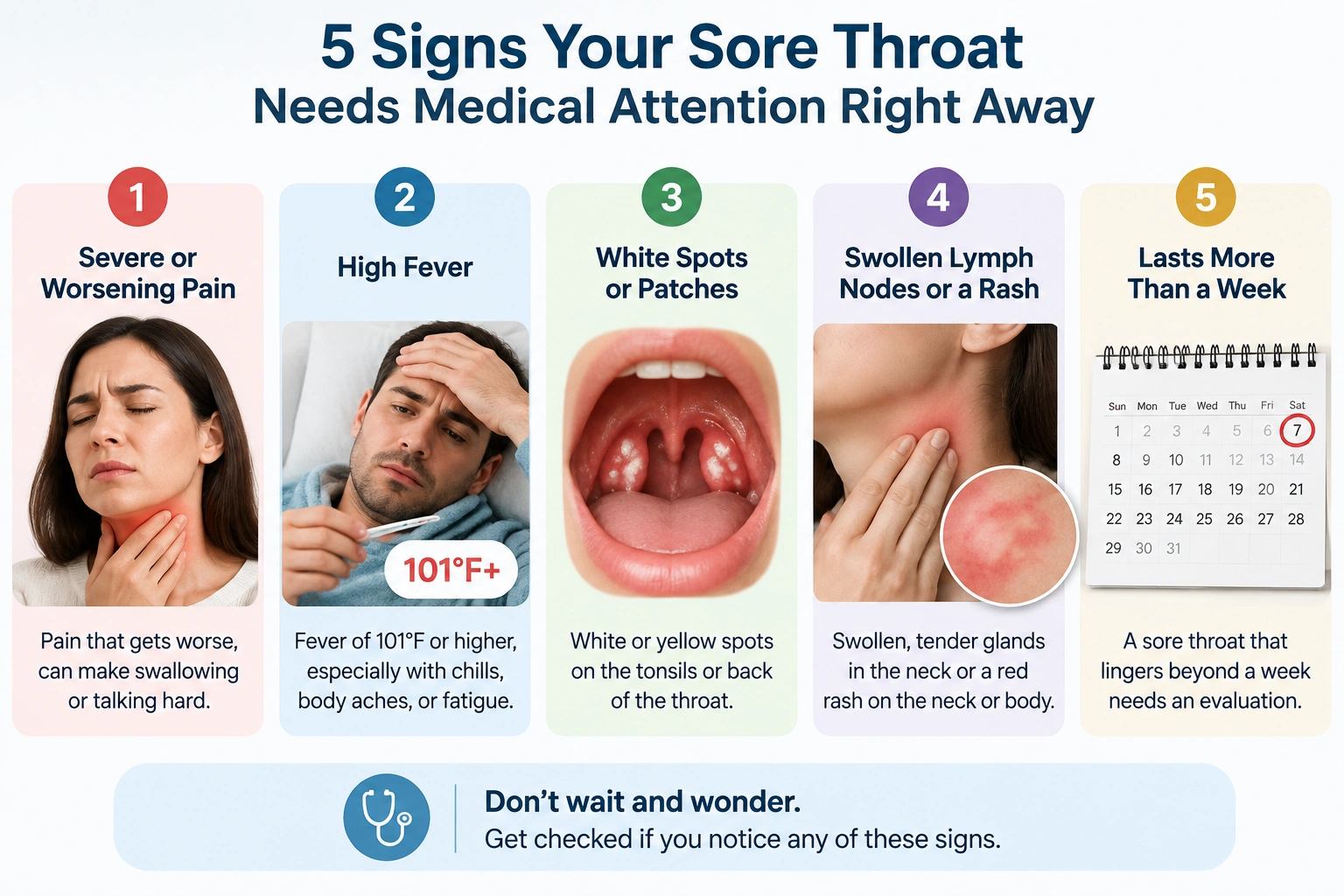
Pain that eases a little each day is a normal sore throat doing what it's supposed to do. Pain that gets worse on day two or three is not.
Watch for pain severe enough to make swallowing liquids hard, talking uncomfortable, or opening your mouth feel tight and restricted. That kind of escalation can mean the infection has moved beyond the throat itself, sometimes into a peritonsillar abscess, a pocket of infection near the tonsil that can follow untreated strep and usually needs to be seen the same day.
A low fever can go along with an ordinary sore throat. One that hits 101°F or higher, especially alongside chills, body aches, and fatigue, points more toward a bacterial infection like strep, or the flu.
This combination matters most in kids, who can go from fine to seriously unwell faster than adults do. A fever that spikes, breaks, then comes back a day or two later deserves a call to your provider, not a shrug.
White or yellow spots on the tonsils or back of the throat look nothing like ordinary redness, more like distinct flecks than an even flush of color. This one is a classic strep or tonsillitis sign, and it almost always means a visit and a rapid strep test.
It's not exclusive to strep, though. In teens and young adults, the same white patches can also mean mono, which is treated differently. For the specifics on strep throat symptoms, we've broken those down in a separate post.
Swollen, tender lymph nodes in the neck mean your body is fighting something real, not just mild irritation. A red rash spreading from the neck down the body is another flag, and combined with a sore throat, it can point to scarlet fever, a strep complication that needs antibiotics promptly.
Sore throat plus rash is a combination that always calls for same-day care. Throat infections can also travel to the ear, especially in kids, so ear pain on top of a sore throat is reason enough on its own to get checked.
A week is about as long as a viral sore throat should last. Past that point without real improvement, it's not patience that's needed, it's an evaluation. A sore throat that lingers can mean mono, chronic tonsillitis, or occasionally something that needs further testing to pin down.
Most people keep assuming it'll clear up any day now. But every day past that one-week mark raises the odds of complications setting in, and getting checked takes far less time than most people assume, often a single visit with an answer the same day.
The five signs above call for prompt care, the kind you'd get at a same-day urgent care visit. A few symptoms go past that and signal a real emergency:
Trouble breathing, drooling, or difficulty swallowing are signs of a possible airway emergency, and they belong in an emergency room, not an urgent care waiting area. If you or your child has any of these, call 911 or get to the ER now.
Catch one of these five signs early, and recovery tends to be faster with fewer complications along the way. If any of them match what you or your child is dealing with, don't wait to see if it passes.
At Metro Urgent Care, a same-day visit means a rapid strep test with in-house results, not a days-long wait to find out what's going on. Board-certified physicians see patients at all three of our Chicago-area locations, Fullerton Ave, Montrose Ave, and La Grange, no appointment required, six days a week.
Come in today and get an answer instead of another day of wondering.
Past seven days without real improvement, it's time to get it checked.
Urgent care handles most severe sore throats, but trouble breathing, drooling, or a stiff neck means the ER instead.
In rare cases, yes: an untreated bacterial infection can spread and lead to complications like an abscess or scarlet fever.
A high fever, white patches, trouble swallowing, or a sore throat past the one-week mark are all good reasons to come in.
Only if it's bacterial, like strep, which is exactly what a quick test is for.


Stay protected this flu season!


